Holographic Human Body
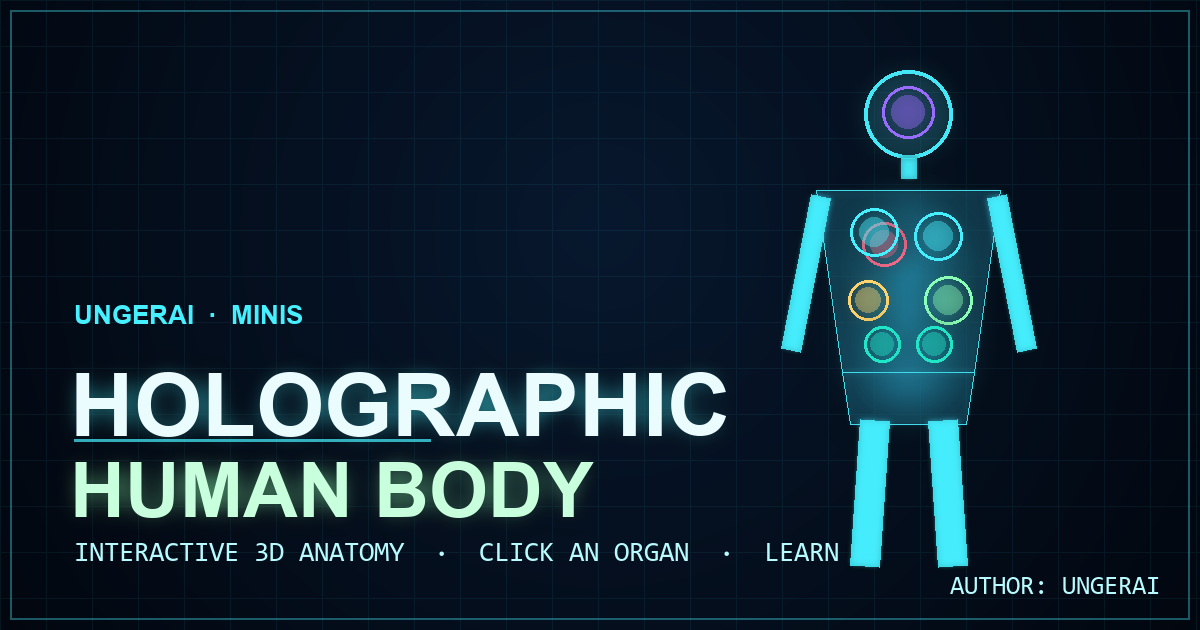
Rotate a glowing 3D human figure and click any internal organ — heart, lungs, brain, liver, kidneys and more — to fly in and read a plain-English explainer: what it is, what it does, key facts, and how to keep it healthy. Twenty organs across seven body systems, all in the browser.
🫀 What is the Holographic Human Body?
It’s a stylized, interactive 3D model of the human body rendered right in your browser with WebGL. A translucent holographic figure floats in space with its organs glowing inside. Toggle the skin layer, switch on X-ray, or filter by body system — then click an organ to zoom in and learn about it in clear, everyday language.
It’s built for curiosity and quick learning, not for diagnosis. Think of it as a friendly museum exhibit you can spin around with your mouse.
The flow
🧠 Twenty organs, seven systems
⚖️ What it is — and isn’t
✓ Great for
- Curious learners, students, and kids exploring anatomy.
- Quick, friendly explanations in plain English.
- Runs in any modern browser — no install, no plugins.
✕ Trade-offs
- Shapes are stylized primitives, not scanned anatomy.
- Positions are approximate for clarity, not precision.
- Covers major organs, not every structure in the body.
△ Not for
- Medical diagnosis, treatment, or clinical training.
- A substitute for a doctor or verified reference.
- Exam-grade anatomical accuracy.
📦 How it works
The whole scene is a single WebGL canvas powered by Three.js. Each organ is built from simple 3D primitives (spheres stretched into ellipsoids, tubes for vessels and intestines, torus rings for the rib cage) and given a glowing, semi-transparent material. A translucent body silhouette wraps around them as the “skin layer.”
- Ray-casting turns a mouse click into the organ underneath it.
- A gentle camera fly-to animation focuses the selected organ.
- Screen-space labels track each organ as you orbit.
- Everything runs client-side — no server, no data collected.
// Turn a pointer click into the organ beneath it
function onPointerDown(event) {
  const rect = canvas.getBoundingClientRect();
  pointer.x = ((event.clientX - rect.left) / rect.width) * 2 - 1;
  pointer.y = -((event.clientY - rect.top) / rect.height) * 2 + 1;
  raycaster.setFromCamera(pointer, camera);
  const hits = raycaster.intersectObjects(selectableMeshes, false);
  const hit = hits.find(h => h.object.userData.partId);
  if (hit) selectPart(hit.object.userData.partId); // opens the explainer + flies in
}Build a single-page interactive 3D "holographic human body" with Three.js (classic global build, no ES modules, so it works over file://). - A translucent glowing human silhouette (head, torso, arms, legs) as a toggleable "skin layer", with organs modelled inside from primitives. - Include ~20 organs across 7 systems (nervous, cardiovascular, respiratory, digestive, urinary, endocrine, skeletal), each a glowing semi-transparent mesh with a pulsing marker and a floating label. - Clicking an organ (via raycasting) flies the camera to it and opens a side panel with: what it is, what it does, key facts, and how to keep it healthy. - Left panel: filter by body system, toggle labels / X-ray / skin layer, reset camera. - Neon holographic UI: dark background, scanlines, grid, cyan/green palette. - Keep it educational and clearly stylized, not a medical device.
🚀 Ready to explore?
Spin the body, peek under the skin, and click your way through twenty organs.
Launch the 3D explorer